

To Be Done
14. Risk Management#
stale text
Fund managers, endowment managers, and professional delegated money managers in general very rarely can allocate capital freely
It is frequently the case that the ultimate investors impose on them a variety of restriction in the investment opportunity set.
Restrictions on the sectors they invest
Restrictions on the whether they can go short
Restrictions on the use of explicit leverage
Restrict on the use of derivative and embedded leverage
These type of restrictions are simple in the sense that they simply limit the set of instruments you are considering.
They are static in nature.
Another set of constraints imposes time-varying restrictions on what the manager can do
Risk limits: given a model for risk, it specifies that the portfolio must have variance lower than a certain limit
Tracking error constraints: given a benchmark, this imposes limits on the portfolio residual risk–the volatility of the portfolio abnormal return relative to the benchmark
What makes implementation of these limits challenging is that risk is highly time-varying.
🎯 Learning Objectives
In this section we will learn how did deeper into risk management By the end of this chapter, you should be able to:
Think about risk as a delegate
Build portfolio risk from the ground up
Decompose factor risk and evaluate best hedging opportunities
Think about risk dynamically
14.1. Risk Taking If You’re the Delegate#
Now imagine you’re a fund manager investing on behalf of others.
You may be evaluated based on:
Performance relative to a benchmark
Short-term volatility
Client satisfaction or redemptions
In this case, your utility function is no longer your own. You may also face:
Constraints (e.g., can’t hold too much cash)
Reputation risks (doing poorly relative to peers)
Incentives tied to short-term returns
The delegate certainly has stop loss rule–at some point the principal will pull the plug
If the manager lose more than that amount they are forced to liquidate their positions and they are likely to be fired
Such stop loss is particularly biding for new managers
This stop loss might be explicit: the fund principal literally tells what it is
But most likely is implicitly–there is a loss that investors will freak out and pull out
You got to think for yourself and have very clearly what the number is
Investing as a delegate without that number in mind is reckless
14.1.1. 🔁 Summary: Why This Distinction Matters#
Perspective |
Risk Tolerance |
Goal |
Constraints |
|---|---|---|---|
Principal |
Personal |
Maximize lifetime utility |
Few (internal) |
Delegate |
Institutional |
Maximize performance within mandate |
Many (external) |
Understanding whether you’re the principal or delegate affects:
Portfolio size,
Reaction to volatility,
Interpretation of performance metrics (like Sharpe ratios).
14.1.2. ✅ Check Your Understanding#
Q1: Why might a delegate choose a lower-risk portfolio than a principal?
Click to see the answer
Because delegates often face external constraints and career risks. Their incentives may penalize short-term underperformance, leading them to reduce exposure to volatility—even if it means lower expected returns.👉 In the next section, we’ll use this framework to build actual portfolios that mix risky and risk-free assets.
14.1.3. From Maximum Losses to Portfolio Risk#
This might have to move to capital allocation II
Lets think in terms of the one-year ahead looses you are comfortable with.
This can come from your internal judgment or from a stop loss reasoning
Lets that you want to loose more than L (L is a number like 20%) with probability lower than p (say 5%)
assume \(rf=\mu\approx 0\)–for example if the horizon is short
first step is to transform our variable in into a standard normal random variable
We have that \(\frac{xrp}{x\sigma(rp)}\sim N(0,1)\), then
Where F is the CDF of a standard normal, and \(F^{-1}\) is it’s quantile function
F takes a number in the real line and returns a probability
\(F^{-1}\) take a probability and returns a number in the real line
Then
Lets do a calculation
for \(p=5 \%\), \(L=30\%\) what do we get?
Note that you will need the normal quantile function
from scipy.stats import norm
norm.ppf(0.05)
-1.6448536269514729
You might want to incorporate your views on the portfolio expected return
That is relevant in case your horizon is one year or longer.
For horizons that are 1 month or shorter you are safe ignoring the expected value since the volatility totally dominates it
You might adjust for deviations from normality by augmenting your losses by a factor \(h\geq1\)
The more you invest, the higher the expected growth \(x\mu+rf\), but also the higher your wealth volatility \(x\sigma\)
Now note that \(F^{-1}(p)\) is a negative number and \(\frac{\mu}{\sigma}\) is positive
Lets first assume \(hF^{-1}(p)+\frac{\mu}{\sigma}<0\) which is the realistic case, unless you are James Simmons
A higher risk-free rate means you can take more vol (holding L fixed), since you start from a higher expected baseline
It is natural to have a real rate here since you probably care about your purchasing power
The higher the Sharpe ratio, the less negative is \(hF^{-1}(p)+\frac{\mu}{\sigma}\) and the higher the volatility you choose to take
The higher your SR, the less likely you hit that loss!
Lets plug some numbers with \(rf=1\%\) and SR=0.4 ( that is the market Sharpe ratio)
from ipywidgets import interact
from IPython.display import display

def calculate_sigma(L, h, p, sr, rf):
	return -(L + rf) / (h * norm.ppf(p) + sr)

@interact(StopLoss=(0.05, 0.5, 0.05), p=(0.01, 0.1, 0.01), h=(1, 4, 0.5), SharpeRatio=(0.1, 3, 0.1))

def calculate_optimal_vol(StopLoss, p, h, SharpeRatio, rf=0.02):
	sigma = calculate_sigma(StopLoss, h, p, SharpeRatio, rf)
	return f"Optimal vol: {sigma:.2%}"
What happens if you take a 10% loss?
What happens if you have a very high SR?
What happens if you suddenly think returns are very fat tailed?
14.1.4. Risk-Budget Constraint#
How this is used in practice?
In practice a fund or a “trading pod” is allocated some capital and some maximum risk-limits
If you breach the risk-limit you have to de-risk
Why is typically so hard to de-risk?
Think about Melvin Capital (fund that failed during the Gamestop craziness)
How should you think about de-risking? Should you comply? What is the trade-off?
What are the incentives the manager faces? What does it depend on?
How are these incentives different from a wealth individual invest in her own behalf?
Should our past losses matter for our decision to de-risk?
14.2. Managing Factor Risk#
The betas measure the exposure of the asset return to the factor, but it does not give an accurate way of thinking which factor drives the most of the variation in the asset as factors can have very different variances
The the variance share of factor j is \(\frac{\beta_{i,j}Cov(r^i_t,f^j_t)}{Var(r^i_t)}\) and the share of non-factor variance is \(\frac{\sigma^2_{\epsilon}}{Var(r^i_t)}\)
VarianceDecomposition=pd.DataFrame([],index=tickers,columns=X.columns[1:])
FactorLoadings=pd.DataFrame([],index=tickers,columns=X.columns[1:])
VarianceIdiosyncratic=pd.DataFrame([],index=tickers,columns=['epsilon'])
for ticker in tickers:
    y = df_ETF[ticker]
    Factors = df_factor.drop(columns=['RF'])
    X = sm.add_constant(Factors)
    X=X[y.isna()==False]
    y=y[y.isna()==False]
    model = sm.OLS(y, X).fit(dropna=True)
    # get the covariance matrix of the factors and the dependent variable
    CovMatrix=pd.concat([y,X.iloc[:,1:]],axis=1).cov()
    # get the column of the covariance matrix corresponding to the dependent variable and exclude itself to get the covariance of
    # the dependent variable with each factor
    FactorLoadings.loc[ticker,:]=model.params[1:]
    VarianceIdiosyncratic.loc[ticker,'epsilon']=model.resid.var()
    VarianceDecomposition.loc[ticker,:]=model.params[1:]*CovMatrix.iloc[1:,0]/y.var()*100
    # Get the residual variance
    VarianceDecomposition.at[ticker,'epsilon']=model.resid.var()/y.var()*100


np.floor(VarianceDecomposition)
| Mkt-RF | SMB | HML | RMW | CMA | MOM | epsilon | |
|---|---|---|---|---|---|---|---|
| MTUM | 85 | -1 | 0 | 1 | 0 | 4 | 8.0 |
| SPMO | 85 | -1 | 0 | 0 | -1 | 2 | 13.0 |
| XMMO | 83 | 4 | 0 | -1 | 0 | -2 | 13.0 |
| IMTM | 68 | -1 | -1 | 1 | -1 | -1 | 31.0 |
| XSMO | 70 | 16 | 1 | -1 | 0 | -3 | 14.0 |
| PDP | 90 | 1 | -1 | 0 | 1 | -2 | 7.0 |
| JMOM | 90 | 0 | 1 | 0 | 0 | -1 | 6.0 |
| DWAS | 64 | 23 | -1 | 2 | 0 | 1 | 8.0 |
| VFMO | 82 | 7 | -2 | 2 | 0 | 2 | 4.0 |
| XSVM | 60 | 18 | 10 | -2 | 0 | 1 | 10.0 |
| QMOM | 58 | 6 | -2 | 3 | 0 | 7 | 23.0 |
What do we learn?
Decompositions like that extensively in the money management industry
Used to classify managers in terms of styles–often called style analysis
Used to control own portfolio factor risk to satisfy investment mandates
When looking at a portfolio/fund you have two approaches to measure it’s factor exposures
Top down: what we did so far. run a time-series regression of the portfolio returns on the factor return
Bottom up: from the asset factor exposures build the portfolio factor exposure
What are the benefits and drawbacks of each?
14.3. Factor risk Limits#
Needs to be integrated
Suppose I have a limit on how much of my portfolio variance can be driven by the factor
How much do you need to hold from the factor to hit a particular target?
You want the factor piece to be less than vbar=20%
so we need
Note that your size of your overall portfolio cancels out.
What matters for the share is your hedge per unit of position
How do I set it to exactly zero?
reorganizing
What is the hedge portfolio if you want zero factor risk?
vbar=0.2
xh20=((vbar*var_e)/((1-vbar)*var_f))**0.5-beta
xh20
-0.4816910986685352
For each dollar invested in the strategy you need to short 50 cents of the market
14.4. Variance-Covariance Matrix Estimation#
A key step in measuring risk well is to have a good estimate of the covariance-matrix
The covariance matrixes can be thought as two pieces
The overall variance of each asset
The degree of co-movement between them, i.e. the correlation
The variance piece tends to be easier–for each asset you need to estimate one moment
The correlation is harder because as the assets grow, the number of correlation grows explosively
Here three different approaches to estimate a portfolio risk
Notation:
a vector of asset excess returns R (N by 1),
weights W (N by 1),
You can estimate your portfolio variance in three different ways
Var(W’R): compute the portfolio in sample return variance
W’Var(R)W: Compute the individual assets variance-covariance matrix
Var(W’ @(A+Bf+U)): Use a factor model
Note that in the first method we skip the estimation of the covariance-matrix and estimated the variance of the portfolio directly
For example, that is the approach that we we take to estimate the market portfolio variance
You are assuming that
What are the advantages and disadvantages of each approach?
Which approach is unlikely to work well for funds that trade a lot?
Which approach needs more data?
\(Var(R)\) can be very large
For N assets, this means estimating \((N^2-N)/2\) correlations and N variances
With limited time-series data our estimator will mistake chance for real relationships
We need need to impose something in the data.
Use factor models:
Essentially assume that all co-movement is captured by the factors
any residual co-movement is noise and we assume it is zero (even if the data says it is not)
Shrink the covariance matrix:
We shrink all correlations to zero
shrink all variances to the average
14.4.1. Factor-Based Covariance Estimation#
Notation
where
B is N by M
F is M by 1
u is N by 1
Then the variance-covariance matrix is
Var_F=Factors.cov()
Cov=FactorLoadings @ Var_F @ FactorLoadings.T + np.diag(VarianceIdiosyncratic.values.reshape(-1))
Cov
| MTUM | SPMO | XMMO | IMTM | XSMO | PDP | JMOM | DWAS | VFMO | XSVM | QMOM | |
|---|---|---|---|---|---|---|---|---|---|---|---|
| MTUM | 0.00016 | 0.000143 | 0.000155 | 0.000117 | 0.000152 | 0.000158 | 0.000141 | 0.000175 | 0.000159 | 0.000139 | 0.000169 |
| SPMO | 0.000143 | 0.000159 | 0.00015 | 0.000114 | 0.000146 | 0.000152 | 0.000137 | 0.000166 | 0.000152 | 0.000138 | 0.00016 |
| XMMO | 0.000155 | 0.00015 | 0.0002 | 0.000127 | 0.000178 | 0.000171 | 0.000153 | 0.000203 | 0.000175 | 0.000173 | 0.000184 |
| IMTM | 0.000117 | 0.000114 | 0.000127 | 0.000136 | 0.000128 | 0.000127 | 0.000115 | 0.000144 | 0.000129 | 0.000127 | 0.000133 |
| XSMO | 0.000152 | 0.000146 | 0.000178 | 0.000128 | 0.000227 | 0.000173 | 0.000154 | 0.000223 | 0.000184 | 0.000198 | 0.000192 |
| PDP | 0.000158 | 0.000152 | 0.000171 | 0.000127 | 0.000173 | 0.000187 | 0.000154 | 0.000198 | 0.000174 | 0.000163 | 0.000184 |
| JMOM | 0.000141 | 0.000137 | 0.000153 | 0.000115 | 0.000154 | 0.000154 | 0.000152 | 0.000173 | 0.000154 | 0.000148 | 0.00016 |
| DWAS | 0.000175 | 0.000166 | 0.000203 | 0.000144 | 0.000223 | 0.000198 | 0.000173 | 0.000284 | 0.000215 | 0.000218 | 0.000229 |
| VFMO | 0.000159 | 0.000152 | 0.000175 | 0.000129 | 0.000184 | 0.000174 | 0.000154 | 0.000215 | 0.000195 | 0.000177 | 0.000196 |
| XSVM | 0.000139 | 0.000138 | 0.000173 | 0.000127 | 0.000198 | 0.000163 | 0.000148 | 0.000218 | 0.000177 | 0.000252 | 0.000175 |
| QMOM | 0.000169 | 0.00016 | 0.000184 | 0.000133 | 0.000192 | 0.000184 | 0.00016 | 0.000229 | 0.000196 | 0.000175 | 0.000281 |
14.4.2. Shrinkage methods#
Say our covariance in the data is \(Var(R)\)
We will then construct our estimator as
the \(\tau\) parameter is the amount of shrinkage
the worse the data is the more you apply
In the limit al correlations are zero and all variances are the same
Sometimes people mix and match–using a factor model and then shrink the residuals covariance matrix
Particularly sensible approach when we know differences in factor exposures are important
tau=0.5
var_avg=df_ret.var().mean()

N=df_ret.shape[1]
Var_shrink=df_ret.cov()*(1-tau)+tau*np.eye(N)
Conceptual check
Suppose you are trying to construct the minimum variance portfolio–say you think expected returns are undistinguishable across the funds, so you simply want to minimize variance
your optimal weight, if you knew the covariance matrix is
If we compare the in-sample Variance of our minimum variance portfolios for
The unrestricted case
The single-factor covariance
The multi-factor covariance
The shrinkage case
which one will have lowest variance? What will have the highest?
Now split the sample in two. Repeat the covariance estimation procedure for each of these approaches for the first half of the sample
Now use the weights to compute the variance of each of the portfolios in the second half
Is the order likely to change?
14.4.3. How will your portfolio risk change as you add positions#
You have portfolio \(X_0\) and you want to sell w of your positions to invest in a fund with portfolio \(X_1\). How your portfolio variance will change as a function of you reallocation?
The answer is simple
But also kind of misleading since you might not have good data to estimate the variance of the new portfolio
Now if you know each portfolio factor betas,\(\beta_0=X_0@B\) and \(\beta_1=X_1@B\) , and at least one of this portfolio is large and well diversified, then for small tilts, i.e. \(w\) small, we have
The fact that one is well diversified just means that you can ignore the covariance-terms of the portfolios asset specific risks
So you see above why a large pool of money when allocating money to an active manager will want to regulate their factor exposure
funds with similar volatilities will be perceived as very different risks depending on how the exposure of portfolio relates to the exposure of the fund
For example, look at how your portfolio risk change if you go from an equal weighted portfolio of these ETFS to just investing in one of them, say MTUM
Here I will use i,j for a individual stock
non-factor component \(u_i\) of the asset return of asset \(i\). Assumed to uncorrelated between any two assets
Now this is just a regression!
We have that
Now to harvest the power of the factor model for risk management we need to make a big assumption
The assumption here is that our factors–in this case a single factor–captures all the co-movement across stocks
This is very strong assumption if you just have a single factor
But gets closer to the truth as you saturate the model with factors (funds use 10-100 factors!)
This assumption is essential to make progress otherwise we are just moving the estimation problem
With this assumption pairwise covariances are fully captured by the factor exposures
And the covariance matrix is simply
We see that now for N assets we only need to estimate N factor exposures, N asset specific volatilities , and the factor volatility
If we were estimating a variance-covariance matrix without imposing the factor model we would have to estimate N covariances and \((N^2-N)/2\) covariance terms: \(2N+1\) vs \((N^2-N)/2+N\) is huge as N grows
Practice
Choose a a few tickers tickers you like plus SPY
Estimate their unrestricted covariance matrix
Estimate the single-factor model (single factor=SPY)
Build the factor implied covariance matrix
Can you compare the number of parameters you need to estimate in each case
Can you discuss if it such model is a good one in this case
Can you calculate the implied portfolio variance for a set of weights of your choosing?
from pandas_datareader.data import DataReader
import datetime


# first we connect with WRDS database using the wrds package so we need to install it first and import it
%pip install wrds
import wrds
# lets connect with  the wrds database
conn = wrds.Connection()

# get our stock returns
Tickers=['WMT','JPM','AAPL','MSFT','GOOGL','AMZN','META','TSLA','NVDA','BRK.B']
df=get_daily_wrds(conn,tickers=Tickers)

# GET RISK FREE RATE
start_date = datetime.datetime(1960, 1, 1)  # Start date (adjust as needed)
end_date = datetime.datetime.now()          # End date
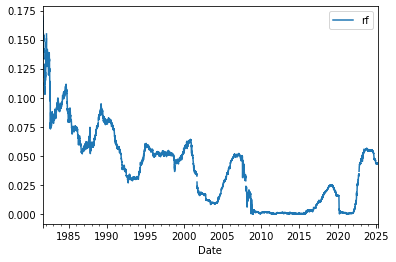
df_rf = DataReader("DGS3MO", "fred", start_date, end_date)
df_rf.reset_index(inplace=True)
df_rf.columns = ["Date", "rf"]
df_rf.rf=df_rf.rf/100
df_rf.set_index("Date", inplace=True)

# merge with the risk-free rate
df=df.merge(df_rf/252, left_index=True, right_index=True,how='left')
#
df_re=df.drop(columns='rf').sub(df['rf'],axis=0)
df_re.tail()
<AxesSubplot:xlabel='Date'>
df_ff6=get_factors('ff6',freq='daily').dropna().drop(columns=['RF'])
df_ff6.tail()

# Define the factors and the market factor

factor = 'Mkt-RF'
df_factor=df_ff6[factor]
df_merged = df_re.merge(df_factor, left_index=True, right_index=True, how='inner')
df_merged.tail()
import statsmodels.api as sm


# Initialize lists to store the results

Beta = []
residuals = []
Alpha_se = []
# Run univariate regressions
# here we are running a regression of each factor on the market factor
for stock in Tickers:
    X = sm.add_constant(df_merged[factor])
    y = df_merged[stock]
    model = sm.OLS(y, X).fit()
    Beta.append(model.params[factor])
    # I am storying the entire time-series of residuals
    residuals.append(model.resid)


Beta = np.array(Beta)

VarF=df_merged[factor].var()
# Calculate the variance-covariance matrix of the residuals
residuals_matrix = np.vstack(residuals)
VarU = np.cov(residuals_matrix)
#now under the assumption that the residuals are uncorrelated ( they are not!)


VarU_uncorr = np.diag(np.diag(np.cov(residuals_matrix.T)))


print("Beta:", Beta)
print("VarU:")
display(VarU*12)
print("VarU_uncorr:")
display(VarU_uncorr*12)
Alpha: [0.00324195 0.04349594 0.03955175 0.04143328 0.08341451]
Beta: [ 0.19954208 -0.13719646 -0.09352601 -0.16246303 -0.16205943]
Sigma_e:
array([[ 1.00563313e-02, -9.24337485e-04, -2.82466739e-03,
        -5.14453377e-04,  1.36587317e-06],
       [-9.24337485e-04,  1.01484903e-02,  3.74978561e-04,
         4.47136746e-03, -3.41595108e-03],
       [-2.82466739e-03,  3.74978561e-04,  5.70013428e-03,
        -3.92044656e-04,  5.51842057e-04],
       [-5.14453377e-04,  4.47136746e-03, -3.92044656e-04,
         4.46193077e-03, -7.83303223e-04],
       [ 1.36587317e-06, -3.41595108e-03,  5.51842057e-04,
        -7.83303223e-04,  2.03162979e-02]])
Sigma_e_uncorr:
array([[0.00083899, 0.        , 0.        , ..., 0.        , 0.        ,
        0.        ],
       [0.        , 0.00270649, 0.        , ..., 0.        , 0.        ,
        0.        ],
       [0.        , 0.        , 0.00027303, ..., 0.        , 0.        ,
        0.        ],
       ...,
       [0.        , 0.        , 0.        , ..., 0.01326286, 0.        ,
        0.        ],
       [0.        , 0.        , 0.        , ..., 0.        , 0.00629202,
        0.        ],
       [0.        , 0.        , 0.        , ..., 0.        , 0.        ,
        0.00475249]])
14.5. Dynamic Risk Management#
The variance of a portfolio is
where
\(X_t\) is your portfolio weights in date t for investment in date t+1,
\(R_{t+1}\) is the vector of asset excess returns during the holding period, i.e. from date \(t\) to date \(t+1\).
\(Var_t()\) denotes the variance of this random variable given all we know in date \(t\)
The idea here is
Correlations do change, but they change slower than variance so we will use standard rolling window to estimate correlations–essentially assuming that they are constant in our forecast horizon.
And use our model to forecast the the variance
IF returns have a factor structure we have
We thus need to produce time-varying estimates
For betas
For factor covariance matrix
For each asset specific idiosyncratic volatility
There is no right way of estimating these things Whatever works best out of sample
We already discussed good approaches to estimate betas and variances (Chapter 8)
Here we simply put these estimates together
One new trick to estimate factor covariances is to build it from correlations and variance estimates
This is useful because correlations tend to move slower than variances
(One can use this trick to estimate betas as well)
We often will rely on the fact that we believe we can measure high frequency variation in market volatility better than in the other factors
Together with the fact that vols tend to move together it is natural to make assumptions like
where Corr is the correlation coming from a 2-5 year moving sample
diag(\Sigma_{F})^{1/2} is a diagonal matrix with factor volatilities estimated at much higher frequencies
Realized variance for the factor (using daily and even intra-day data)
Garch/ARCH models
Option implied volatility (specially for the market, but VIX can be useful more broadly)
Below we will do an example where we build a covariance matrix using this “mixed frequency” approach
14.6. Tracking Error Mandates#
Active managers operating in a mutual often have limits on how much they can deviate from their benchmark
This happens at the same time that they have incentives to beat it , i.e. their value added is \(E[R-R^b]\)
What is the difference between this notion of value added and alpha?
The tracking error is simply the volatility of a relative return
In the ideal scenario you have a constant edge relative to the benchmark–no no tracking error–but still value added
Of course that is virtually impossible, so you accept some tracking error to get some extra
You are effectively short the benchmark
To zero your vol you simply hold the benchmark portfolio
Benchmarks are typically tradable. A very common one is the S&P500
Your tracking error has two parts
The first piece is your exposure to the benchmark.
How can you get this piece to zero? Is it costly?
The second piece is everything else
how can you get to zero? is it costly?
Your value added also has two pieces
If benchmark has positive premium you can “beat it” simply by investing in higher beta stocks! (or leveraging up)
For example if you have no original ideas and have a track record allowance of 5% how much value added you can produce?
What your answer depends on?
Suppose you also have good trading ideas, i.e. alpha, how do you trade-off beta and alpha if your goal is to maximize value added?
How is this related to the “betting against beta” phenomena?