

9.18. Momentum#
Momentum is the fact that stocks that have performed relatively well in the past continue to perform relatively well in the future, and stocks that have performed relatively poorly, continue to perform relatively poorly.
A Momentum investment or “relative strength” strategy buys stocks which have performed relatively well in the past and sells (shorts) stocks which have performed relatively poorly. Over the 1963-1990 time period, Jegadeesh and Titman (1993) found that a strategy that ranked stocks based on their past 6 months to a year returns, and bought the top 10% and shorted the bottom 10% based on this ranking, produced abnormal returns of 12% per year.
Momentum portfolios bet on cross-sectional continuation. That is, in a stock did well relative to others in the recent past, the bet is that will continue to do better than the average going forward.
In some ways momentum is the opposite of a value strategy , since value stocks are stocks that have had very low returns (how else they would be value?)
The difference is that value/growth focus on the valuation ratio as the signal of how low the price is. So the valuation ratio captures the entire history of returns (what is price if not the result of the historical returns). Momentum instead focus on the last 12 months. Recent, but not too recent. But there many versions of Momentum.
9.18.1. Signal Construction#
We have build portfolios using pre-constructed signals.
These signals are well known and therefore made them an unlikely source of large Sharpe ratios.
A quant fund aims to construct new characteristics based on new data or new ideas of how to combine the relevant public information.
So signal construction is ART and not science. There is no recipe here and each signal is constructed differently.
We will have an overview of the main factors used in the industry–hold tight!
Now our goal is to learn one particular technique of factor construction that is based on past returns.
I like to over this one because it enable you to do many different variations as we will see.
9.18.2. Libraries and all that#
import pandas as pd
import numpy as np
import matplotlib.pyplot as plt
%matplotlib inline

import pandas_datareader.data as web

import datetime as dt

from dateutil.relativedelta import *
from pandas.tseries.offsets import *
Construction
Here is how Daniel and Moskowitz construct their portfolios
To form the momentum portfolios, we first rank stocks based on their cumulative returns from 12 months before to one month before the formation date (i.e., the t-12 to t-2-month returns), we use a one month gap between the end of the ranking period and the start of the holding period to avoid the short-term reversals documented by Jegadeesh (1990) and Lehmann (1990). In particular we will focus on 10% and 90% quantiles of the signal distribution and will construct portfolios of all stocks that are in the bottom and top quintiles
Get monthly returns and market equity data for all us firms
Compute rolling cumulative 11 month returns
Lag signal by one month because rolling average includes current month.
This makes the signal cumulative returns form t-11 to t-1
It is a valid signal to bu at closing price of date t-1 to earn date t returns
But that is not yet what we want
Lag another month to be consistent with the t-12 to t-2 month construction
Groups stocks according to this signal
Form portfolios
9.18.2.1. Load return and market cap data by firm/date#
url = "https://github.com/amoreira2/UG54/blob/main/assets/data/crspm2002_2024.pkl?raw=true"
crsp = pd.read_pickle(url)


# construction of market equity
crsp=crsp[['permco','permno','ticker','date','ret','shrout','prc']].copy()
# change variable format to int
crsp[['permno']]=crsp[['permno']].astype(int)
crsp[['permco']]=crsp[['permco']].astype(int)
# Line up date to be end of month
crsp['date']=crsp['date']+MonthEnd(0)
# calculate market equity
# why do we use absolute value of price?
crsp['me']=crsp['prc'].abs()*crsp['shrout']
# drop price and shareoustandng since we won't need it anymore
crsp=crsp.drop(['prc','shrout'], axis=1)
crsp_me=crsp.groupby(['date','permco'])['me'].sum().reset_index()
# largest mktcap within a permco/date
crsp_maxme = crsp.groupby(['date','permco'])['me'].max().reset_index()
# join by jdate/maxme to find the permno
crsp=pd.merge(crsp, crsp_maxme, how='inner', on=['date','permco','me'])
# drop me column and replace with the sum me
crsp=crsp.drop(['me'], axis=1)
# join with sum of me to get the correct market cap info
crsp=pd.merge(crsp, crsp_me, how='inner', on=['date','permco'])
# sort by permno and date and also drop duplicates
crsp=crsp.sort_values(by=['permno','date']).drop_duplicates()
crsp.head()
| permco | permno | ticker | date | ret | me | |
|---|---|---|---|---|---|---|
| 212 | 7953 | 10001 | EWST | 2002-01-31 | -0.013100 | 28995.8000 |
| 213 | 7953 | 10001 | EWST | 2002-02-28 | -0.053097 | 27488.3000 |
| 214 | 7953 | 10001 | EWST | 2002-03-31 | -0.015888 | 26738.4000 |
| 215 | 7953 | 10001 | EWST | 2002-04-30 | -0.043269 | 25581.4500 |
| 216 | 7953 | 10001 | EWST | 2002-05-31 | 0.014824 | 25960.6725 |
9.18.2.2. Construct rolling cumulate the returns#
We need to construct the returns from t-11 to t:
We will now cumulate the returns of each asset on a rolling basis. As described in the procedure we wll look back for 11 months and compute the cumulative return in the period.
df=crsp.copy()
df['1+ret']=(df['ret']+1)
df=df.set_index(['date'])
temp=(df.groupby('permno')[['1+ret']]).rolling(window=12, min_periods=7).apply(lambda x: x.prod(), raw=True)
temp=temp.rename(columns={'1+ret':'cumret12'})
temp =temp.reset_index()
temp.tail(5)
| permno | date | cumret12 | |
|---|---|---|---|
| 1130765 | 93436 | 2024-08-31 | 0.829626 |
| 1130766 | 93436 | 2024-09-30 | 1.045600 |
| 1130767 | 93436 | 2024-10-31 | 1.244025 |
| 1130768 | 93436 | 2024-11-30 | 1.437688 |
| 1130769 | 93436 | 2024-12-31 | 1.625242 |
9.18.2.3. Merge Signal with returns#
We now merge back this cumret11 variable with our data set
Reset the
dfindex so bothpermnoanddateare normal columns.This makes the merge easier
df = pd.merge(df.reset_index(), temp[['permno','date','cumret12']], how='left', on=['permno','date'])
9.18.2.4. Get the timing right#
The first month to make sure the signal is tradable, so that is mandatory to make this a valid strategy without look-ahead bias
We do an additional month, so lag by 2, because we will be skipping a month between the last return data used in the signal and the time we buy the stock
so we cumulate returns up to t-2, and form the portfolio in beginning of month t, so return t-1 does not go either in the signal or in our strategy
For example, for the portfolio formed in the last day of december-2024 and held till the last day of january-2025, our signal is the cumulative return from the last day of december-2023 till the last day of november-2024.
So the returns for the month of december-2024 are skipped and not used in the signal construction
Before lagging it always important to sort the values so the result is what you intended
df=df.sort_values(['date','permno'])
df['mom']=df.groupby('permno')['cumret12'].shift(2)
# why I am groupby permno here befroe lagging?
# drop the row if any of 'mom' is missing
df=df.dropna(subset=['mom'], how='any')
df=df.drop(['1+ret','cumret12'], axis=1)
# lag market cap
df['me_l1']=df.groupby('permno')['me'].shift(1)
df.tail()
| date | permco | permno | ticker | ret | me | mom | me_l1 | |
|---|---|---|---|---|---|---|---|---|
| 1128354 | 2024-12-31 | 53407 | 93374 | FAF | -0.102210 | 6.431570e+06 | 1.291193 | 7.225731e+06 |
| 1129015 | 2024-12-31 | 53423 | 93397 | LMNR | -0.117446 | 4.410872e+05 | 1.819149 | 5.013174e+05 |
| 1130094 | 2024-12-31 | 53443 | 93426 | VPG | 0.021768 | 2.867095e+05 | 0.775736 | 2.806015e+05 |
| 1130571 | 2024-12-31 | 53427 | 93434 | SANW | 0.133333 | 1.824916e+04 | 0.180757 | 1.610220e+04 |
| 1130769 | 2024-12-31 | 53453 | 93436 | TSLA | 0.170008 | 1.296351e+09 | 1.244025 | 1.107984e+09 |
9.18.3. Portfolio formation#
We can now simply use the function we just build to construct characteristic-based portfolios
Just make sure that our labels here are consistent with what we had before
def returnbyX(df,y='ret',X='value',ngroups=10,plot=True):
    df['X_group']=df.groupby(['date'])[X].transform(lambda x: pd.qcut(x, ngroups, labels=False,duplicates='drop'))
    ret =df.groupby(['date','X_group']).apply(lambda x:(x[y]*x['me_l1']).sum()/x['me_l1'].sum())
    ret=ret.unstack(level=-1)
    if plot:
        if y=='ret':
            (ret+1).cumprod().plot(logy=True)
        else:
            ret.plot()
    return ret


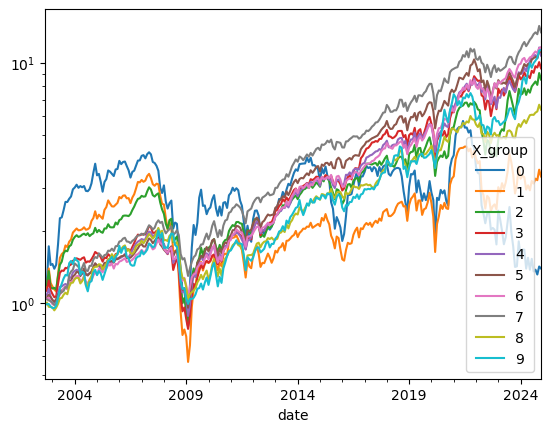
returnbyX(df,y='ret',X='mom',ngroups=10,plot=True)
/var/folders/ft/hpl8ntq506jgz116vbqnwqj40000gp/T/ipykernel_81286/3636907694.py:3: RuntimeWarning: invalid value encountered in scalar divide
  ret =df.groupby(['date','X_group']).apply(lambda x:(x[y]*x['me_l1']).sum()/x['me_l1'].sum())
/var/folders/ft/hpl8ntq506jgz116vbqnwqj40000gp/T/ipykernel_81286/3636907694.py:3: DeprecationWarning: DataFrameGroupBy.apply operated on the grouping columns. This behavior is deprecated, and in a future version of pandas the grouping columns will be excluded from the operation. Either pass `include_groups=False` to exclude the groupings or explicitly select the grouping columns after groupby to silence this warning.
  ret =df.groupby(['date','X_group']).apply(lambda x:(x[y]*x['me_l1']).sum()/x['me_l1'].sum())
| X_group | 0 | 1 | 2 | 3 | 4 | 5 | 6 | 7 | 8 | 9 |
|---|---|---|---|---|---|---|---|---|---|---|
| date | ||||||||||
| 2002-09-30 | NaN | NaN | NaN | NaN | NaN | NaN | NaN | NaN | NaN | NaN |
| 2002-10-31 | 0.209799 | 0.158546 | 0.184425 | 0.124120 | 0.081724 | 0.055959 | 0.045086 | 0.036194 | 0.004343 | -0.010977 |
| 2002-11-30 | 0.424524 | 0.203033 | 0.146892 | 0.105215 | 0.060791 | 0.025019 | 0.006972 | -0.009587 | -0.038439 | 0.003013 |
| 2002-12-31 | -0.164175 | -0.129545 | -0.142777 | -0.089586 | -0.074502 | -0.020326 | -0.031922 | -0.007599 | -0.002252 | -0.023626 |
| 2003-01-31 | 0.009969 | -0.033177 | -0.012791 | -0.036224 | -0.029866 | -0.028075 | -0.027832 | -0.015244 | -0.004285 | -0.015818 |
| ... | ... | ... | ... | ... | ... | ... | ... | ... | ... | ... |
| 2024-08-31 | -0.113229 | -0.024316 | 0.023114 | -0.019515 | 0.011487 | 0.014669 | 0.028635 | 0.032678 | -0.001370 | 0.044632 |
| 2024-09-30 | 0.016725 | 0.048126 | 0.024836 | 0.065729 | 0.003556 | 0.012473 | 0.021077 | 0.017939 | 0.021768 | 0.024202 |
| 2024-10-31 | -0.045007 | -0.014535 | -0.031926 | -0.012691 | -0.026328 | -0.015257 | -0.014802 | -0.017944 | 0.011650 | 0.028295 |
| 2024-11-30 | 0.079460 | 0.105816 | 0.120220 | 0.053275 | 0.105133 | 0.071458 | 0.047216 | 0.082817 | 0.066339 | 0.070766 |
| 2024-12-31 | -0.018761 | -0.063070 | -0.060842 | -0.057389 | -0.075196 | -0.009594 | 0.010479 | -0.058944 | -0.046404 | 0.004959 |
268 rows × 10 columns
9.18.4. Wrapping all in a function that goes from the Return/market cap data to the final signal-sorted portfolio#
Things to try
Play with different look-back windows
Play with how many months to skip (1 is the minimum to make the strategy valid. 2 is the standard.) - What do you think it will happen if you don’t skip and let the signal overlap with the return data? - What happens if you skip more months?
What happens if you sort only on the month that the standard momentum skips?
what if you sort on very long-term momentum, like 60 months?
Cumulative returns is just one possible moment to look at
What about volatility?
What about covariance with the market?
What about maximum/minimum return?
# put it all together in a fuction
def momentum(df,ngroups=10,lookback=12,extraskip=1):
    df['1+ret']=(df['ret']+1)
    df=df.set_index(['date'])
    temp=(df.groupby('permno')[['1+ret']]).rolling(window=lookback,min_periods=lookback).apply(np.prod, raw=True)
    temp=temp.rename(columns={'1+ret':'signal_contemp'})
    temp =temp.reset_index()
    df = pd.merge(df.reset_index(), temp[['permno','date','signal_contemp']], how='left', on=['permno','date'])
    df=df.sort_values(['date','permno'])
    df['me_l1']=df.groupby('permno')['me'].shift(1)
    df['signal']=df.groupby('permno')['signal_contemp'].shift(1+extraskip)
    df=df.dropna(subset=['signal'], how='any')
    ret=returnbyX(df,y='ret',X='signal',ngroups=10,plot=True)

    return ret
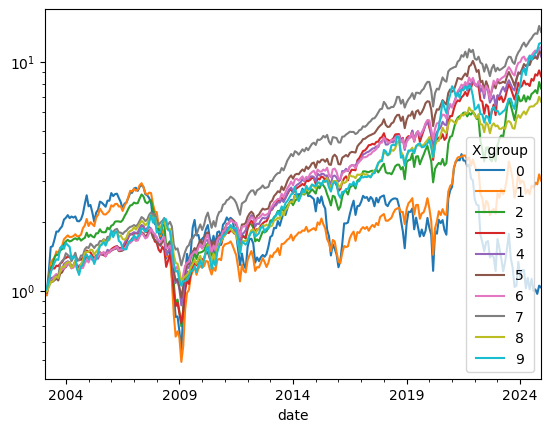
momentum(crsp,ngroups=10,lookback=12,extraskip=1)
/var/folders/ft/hpl8ntq506jgz116vbqnwqj40000gp/T/ipykernel_81286/3636907694.py:3: DeprecationWarning: DataFrameGroupBy.apply operated on the grouping columns. This behavior is deprecated, and in a future version of pandas the grouping columns will be excluded from the operation. Either pass `include_groups=False` to exclude the groupings or explicitly select the grouping columns after groupby to silence this warning.
  ret =df.groupby(['date','X_group']).apply(lambda x:(x[y]*x['me_l1']).sum()/x['me_l1'].sum())
| X_group | 0 | 1 | 2 | 3 | 4 | 5 | 6 | 7 | 8 | 9 |
|---|---|---|---|---|---|---|---|---|---|---|
| date | ||||||||||
| 2003-02-28 | -0.044453 | -0.028858 | 0.007149 | -0.029527 | -0.021365 | -0.016318 | -0.008955 | -0.020221 | -0.027356 | 0.001433 |
| 2003-03-31 | 0.039009 | -0.018667 | -0.018015 | 0.008300 | 0.013862 | 0.024158 | 0.006449 | 0.018332 | 0.025599 | 0.020758 |
| 2003-04-30 | 0.217844 | 0.173348 | 0.143080 | 0.127393 | 0.080637 | 0.047118 | 0.055315 | 0.057230 | 0.037749 | 0.081613 |
| 2003-05-31 | 0.282895 | 0.177494 | 0.111001 | 0.112369 | 0.058234 | 0.030266 | 0.045033 | 0.038495 | 0.053586 | 0.087331 |
| 2003-06-30 | 0.007658 | 0.037203 | 0.030406 | 0.021019 | 0.004246 | 0.007020 | 0.018084 | 0.011128 | 0.004526 | 0.048356 |
| ... | ... | ... | ... | ... | ... | ... | ... | ... | ... | ... |
| 2024-08-31 | -0.113011 | -0.017932 | 0.015203 | -0.018115 | 0.011436 | 0.014057 | 0.029033 | 0.033110 | 0.000013 | 0.043012 |
| 2024-09-30 | 0.013679 | 0.048270 | 0.023013 | 0.066484 | 0.003841 | 0.012194 | 0.021077 | 0.017986 | 0.021735 | 0.024223 |
| 2024-10-31 | -0.043546 | -0.015442 | -0.031454 | -0.012811 | -0.026328 | -0.014821 | -0.023754 | -0.005186 | 0.011622 | 0.028227 |
| 2024-11-30 | 0.086038 | 0.104725 | 0.119969 | 0.053923 | 0.105346 | 0.071177 | 0.047194 | 0.082832 | 0.066352 | 0.070899 |
| 2024-12-31 | -0.018010 | -0.060378 | -0.061811 | -0.057484 | -0.075506 | -0.009269 | 0.010485 | -0.057843 | -0.048558 | 0.006712 |
263 rows × 10 columns
9.18.5. Return-Based Signals: a summary#
Long-term reversals
DeBondt and Thaler (1985)
3-5 year contrarian strategy
Short-term (< 1 month) reversals
Jegadeesh (1990), Lehman (1990), Lo andMacKinlay (1988)
Intermediate horizon continuation
Jegadeesh and Titman (1993)
3-12 month momentum strategy
profits dissipate over 1-year and start to reverse after 2-3 years -> temporary price effect.
see similar pattern around earnings announcements (both earnings and price momentum).
9.18.6. Why this might work?#
Behavioral view: The idea here is that markets might be slow to incorporate information, so good/bad news gets into prices slowly over time. For example investors might only slowly get into prices the consequences of a Trump second term.
Rational view: Maybe all these stocks are exposed to the same missing risk-factor. They all went up and down at the same time after all! For example all firms that went down in march 2020 are particularly exposed to Covid and the ones that did well are positively exposed. So they will move together as COVID risk fluctuate. It is hard to use a story like that to explain the premium, but it is easy to see how it explains the co-movement.
My overall sense is that the majority of academics think that momentum is driven by “behavioral” factors. Note however that momentum tends to crash very badly in high volatility periods such as 2008 and 2020, so it is certainly risky if you zoom out a bit.
Literature
Lots of work on this.
9.18.7. Other “returns” based strategies#
One can easily adapt the code to reproduce a variety of investment strategies that only rely on return information, broadly described as “technical” strategies
Short-term Reversals: Sort stocks based on returns in month t-1, but in the beginning of month t
Long-term reversals: Sort on cumulative returns of the last 5 years
Volatility: sort on the return volatility of the last 24 months, say using returns between t-24 to t-1 and form the portfolio in beginning of date t.
(HARDER) Market beta: Sort stocks based on their beta with the market portfolio. Say estimate beta using the last 60 months of data (t-60 to t-1) and form portfolio at the beginning of date t.
Below is a plot that summarizes the empirical evidence on return-based strategies. It shows the Sharpe Ratio as a function of the lookback period of the return signal

Can you reproduce this plot?
⚡ ⏰ Question 1 ⚡
Building on a function above, create a for loop that reproduces this plot above.
Start by telling me what do you want to do
Then explain how you will get it done
__=[]
results=pd.DataFrame(index=__)
for __ in __:
  ret=__
  LS=__
  results[_]=__

results.plot()
⚡ ⏰ Question 2 ⚡
Modify the Momentum function to create a trading strategy that goes long the 10% stocks with lowest volatility in the previous 24 months and goes short the 10% stocks with the highest volatility in the previous 24 months
⚡ ⏰ Question 3 ⚡
Modify the Momentum function to create a trading strategy that signal weights using the momentum signal. The strategy must still have a blanced long and short portfolio, i.e. the long and the short must have portfolios that add up to 1. But within each portfolio you are taking positions proportional to the signal
⚡ ⏰ Question 4 ⚡
It this portfolio easy to trade? Is it likely to be easier of harder than then signal-sorted, market-cap wegithed portfolios?
9.18.8. 📝 Key Takeaways#
Momentum is a trading strategy that exploits the tendency of past winning stocks to continue performing well and past losing stocks to continue performing poorly.
The standard momentum strategy involves ranking stocks based on their cumulative returns over the past 12 months (excluding the most recent month to avoid short-term reversals) and forming portfolios based on these rankings.
A key aspect of constructing a valid momentum signal is ensuring there is a time lag between the lookback period for calculating the signal and the holding period of the portfolio to avoid look-ahead bias.
Momentum strategies, while historically profitable, can experience significant drawdowns during periods of high market volatility.
Return-based strategies are not limited to momentum; other variations include short-term reversals, long-term reversals, and strategies based on volatility or market beta.
Constructing these strategies involves defining a signal based on past returns or other historical data, sorting stocks based on this signal, and forming portfolios (e.g., long-short portfolios of the top and bottom quantiles).
The empirical evidence suggests varying levels of profitability for different return-based strategies depending on the lookback period and other parameters.